Search
Sort / Filter


Railways and biofuel final report
Railway Stations - Boosting the City

Low Carbon Rail Challenge Technical Report
UIC, the International Railway Association, has announced a transport sector challenge in the framework of the green growth agenda and climate change perspective for 2030 and 2050. This challenge sets out ambitious but achievable targets for improvement of rail sector energy efficiency, reductions in greenhouse gas (GHG) emissions and a more sustainable balance between transport modes. These targets have been voted unanimously by UIC worldwide members in UIC General Assembly, held in Paris on June 27th 2014.
These worldwide voluntary reduction objectives follow what has already been put into practice at the European level by UIC and CER with the “European Rail Sector Sustainable Mobility Strategy” that envisages specific targets for energy efficiency, CO2 emissions reduction, PM/NOx emissions reduction and noise reduction to be met by the EU railway sector in 2030 and 2050.
In order to monitor the environmental performance of the European Railway Sector, the UIC Environmental Strategy Reporting System (ESRS) has been created as a comprehensive instrument which allows the overall procedure of construction of indicators, data collection, analysis, reporting and data sharing to be regulated in a clear and transparent structure.
These worldwide voluntary reduction objectives follow what has already been put into practice at the European level by UIC and CER with the “European Rail Sector Sustainable Mobility Strategy” that envisages specific targets for energy efficiency, CO2 emissions reduction, PM/NOx emissions reduction and noise reduction to be met by the EU railway sector in 2030 and 2050.
In order to monitor the environmental performance of the European Railway Sector, the UIC Environmental Strategy Reporting System (ESRS) has been created as a comprehensive instrument which allows the overall procedure of construction of indicators, data collection, analysis, reporting and data sharing to be regulated in a clear and transparent structure.
111220 com 2011 907 final en
Rail 2050 Vision
The Railway Operating Community (ROC) involvement in EU projects - 2017
RICG Common Collaboration Working Group
120413 oj l 103 4 en

Rethinking Stations for Future Intermobility
Potential of modal shift to rail transport - Study on the projected effects on GHG emissions and transport volumes (March 2011)
Rail transport has significant potential to lower CO2 emissions through modal shift, concludes expert study.
The study, “Potential of modal shift to rail transport - Study on the projected effects on GHG emissions and transport volumes” was commissioned by the Community of European Railway and Infrastructure Companies (CER) and the International Union of Railways (UIC) to consider the potential levels of modal shift to rail, and in particular the greenhouse gas (GHG) reduction savings that could result. It was undertaken by the consultancies CE Delft (Netherlands) and TRT (Italy).
The study gives important detail on how modal shift to rail can help reach the targets outlined in the European Commission’s recent Transport White Paper*. An assessment of the available infrastructure capacity shows that through maximising use of existing infrastructure alone, a 30-40% growth in train-kilometres in 2020 could be accommodated. If this increased capacity was allocated equally to freight and passenger services, rail freight traffic could grow by 83% and passenger transport by 23% over the whole network.
The report says there is particular scope for rail freight to increase its market share in certain segments such as international containerised transport, with the feasibility of growth already clearly demonstrated in countries such as Switzerland, and at the port of Rotterdam where levels of modal split that include the doubling of rail traffic have been set for hinterland container traffic.
For passenger transport, the GHG reduction potential is less clear-cut, although the maximum modal shift calculated has been a reduction of 70 Mtonne CO2-eq. in the EU-27 (9% of passenger transport emissions).
The study also considered the implications of the ‘2050 vision’ of transport Commissioner Siim Kallas, outlined in Berlin in 2010. Under his proposals, rail would be the dominant mode for long-distance transport (corresponding to a 38% modal share for total freight transport and a 27% share in passenger transport).
If implemented, this would result in an annual GHG reduction of 238 Mtonne of CO2-eq., or 21% of total transport emissions. While this would require heavy investment in rail infrastructure (EUR 1,300-2,000 billion), full internalisation of external and infrastructure costs could contribute significantly to the funding of this, the report adds.
The study, “Potential of modal shift to rail transport - Study on the projected effects on GHG emissions and transport volumes” was commissioned by the Community of European Railway and Infrastructure Companies (CER) and the International Union of Railways (UIC) to consider the potential levels of modal shift to rail, and in particular the greenhouse gas (GHG) reduction savings that could result. It was undertaken by the consultancies CE Delft (Netherlands) and TRT (Italy).
The study gives important detail on how modal shift to rail can help reach the targets outlined in the European Commission’s recent Transport White Paper*. An assessment of the available infrastructure capacity shows that through maximising use of existing infrastructure alone, a 30-40% growth in train-kilometres in 2020 could be accommodated. If this increased capacity was allocated equally to freight and passenger services, rail freight traffic could grow by 83% and passenger transport by 23% over the whole network.
The report says there is particular scope for rail freight to increase its market share in certain segments such as international containerised transport, with the feasibility of growth already clearly demonstrated in countries such as Switzerland, and at the port of Rotterdam where levels of modal split that include the doubling of rail traffic have been set for hinterland container traffic.
For passenger transport, the GHG reduction potential is less clear-cut, although the maximum modal shift calculated has been a reduction of 70 Mtonne CO2-eq. in the EU-27 (9% of passenger transport emissions).
The study also considered the implications of the ‘2050 vision’ of transport Commissioner Siim Kallas, outlined in Berlin in 2010. Under his proposals, rail would be the dominant mode for long-distance transport (corresponding to a 38% modal share for total freight transport and a 27% share in passenger transport).
If implemented, this would result in an annual GHG reduction of 238 Mtonne of CO2-eq., or 21% of total transport emissions. While this would require heavy investment in rail infrastructure (EUR 1,300-2,000 billion), full internalisation of external and infrastructure costs could contribute significantly to the funding of this, the report adds.
P38T9001 FFFIS for GSM R SIM CARD v5 0

15 September 2026
Innovation Workshop “From chat to action: will Agentic AI transform the travel experience?” takes place

15 September 2026
Investment in rail: 6th International Symposium on High-Speed Rail Socioeconomic Impacts

15 September 2026
Connecting the continent: UIC launches the Regional Competence Hub Africa
14 September 2026
New working groups launched to continue the IRS migration process

7 September 2026
Translating ideas into impact: How the UIC Academic Board for Innovation is driving global rail collaboration

7 September 2026
UIC launches a new cycle of the UIC Global Mentoring Programme for Railway Talent

27 July 2026
Rolling stock training programme successfully completed in Ankara

27 July 2026
Register now for the UIC webinar on railway fuel filtration for internal combustion engines
24 July 2026
Latest UIC publications on rolling stock
23 July 2026
UIC visits the Hitachi Rail plant in Pistoia, Italy
 now: 1789689600 date: 1789689600
The UIC Sustainability Impact Awards 2026
2026-09-18 14:58:58
 now: 1789689600 date: 1789689600
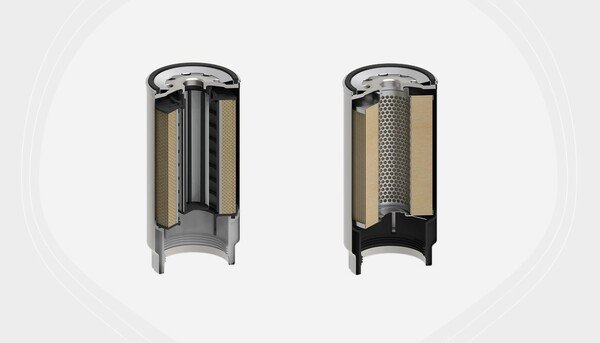
Railway Fuel Filtration for Internal Combustion Engines
2026-09-18 14:58:58
 now: 1789689600 date: 1789689600
UIMC Congress 2026
2026-09-18 14:58:58
 now: 1789689600 date: 1789689600
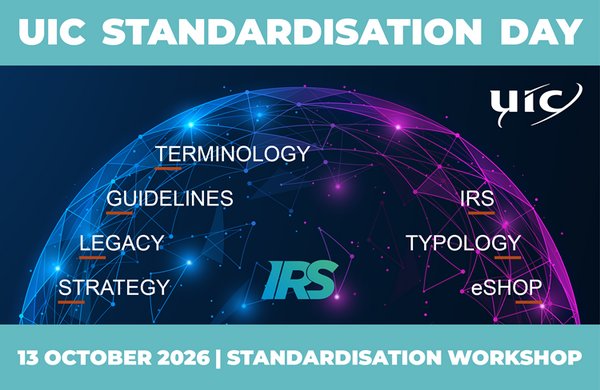
UIC Standardisation Day
2026-09-18 14:58:58
 now: 1789689600 date: 1789689600
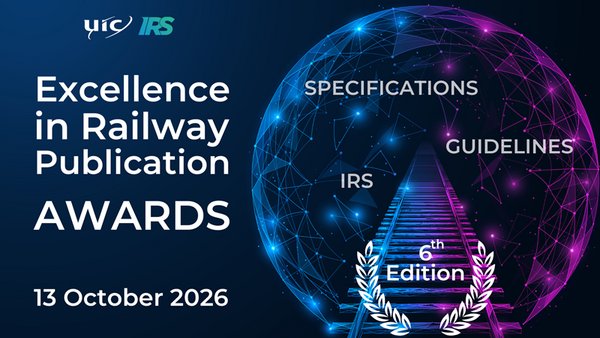
Excellence in Railway Publications Award 2026
2026-09-18 14:58:58
 now: 1789689600 date: 1789689600
56th Watford Conference
2026-09-18 14:58:58
 now: 1789689600 date: 1789689600
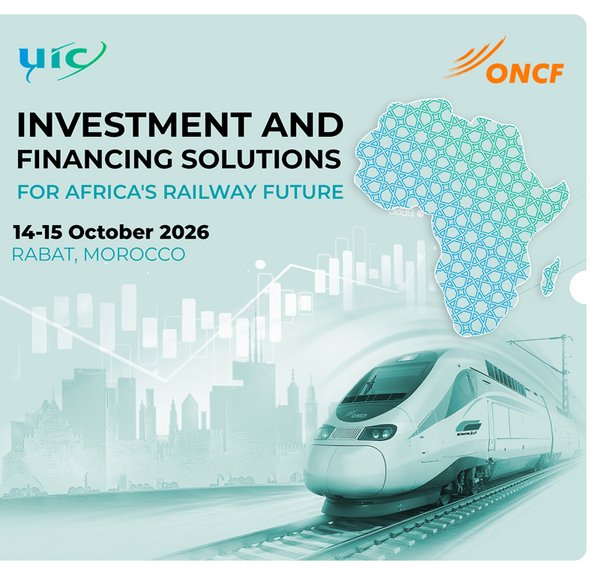
Investment and Financing Solutions for Africa’s Railway Future
2026-09-18 14:58:58
 now: 1789689600 date: 1789689600
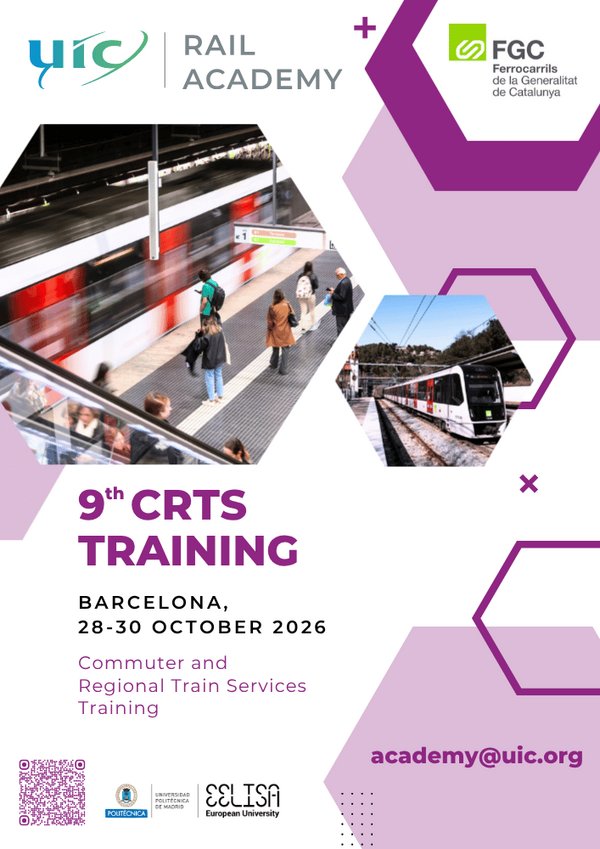
9th Training on Commuter and Regional Train Services
2026-09-18 14:58:58
 now: 1789689600 date: 1789689600
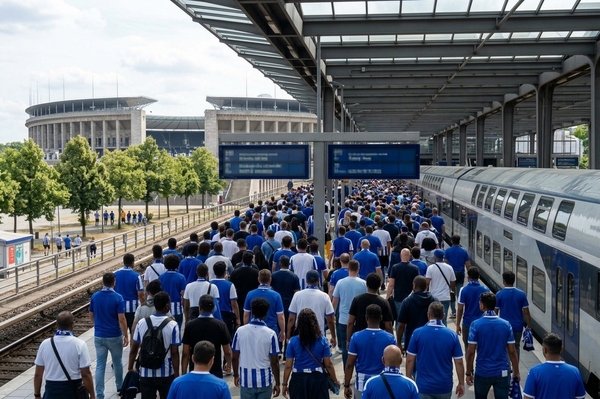
Africa Region Training session: Security of major events
2026-09-18 14:58:58
 now: 1789689600 date: 1789689600
5th Global FRMCS Conference
2026-09-18 14:58:58