Search
Sort / Filter

TransItion STRategy on vegetAtion Management

Ecosystem Valuation for Railways

New Alternative vegetation management TechniqUes (…)


Data-based analysis for SAFETY and security (…)

Biodiversity and infrastructure synergies and (…)

ERTMS delivering flexible and reliable rail traffic (2006)
A comprehensive document from the European Commission
Rail 2050 Vision

Requirements of Railway Undertakings for the Implementation of European Rail Freight Corridors (2014)
Rail Adapt Report
Management of Covid-19 - Guidance for railway stakeholders


“Process, Power, People – Energy efficiency for Railway Managers” - UIC 2008
Energy Efficiency and the reduction of CO2 emissions are crucial topics for the railways for two reasons: financial savings and political priorities. This brochure promotes best practices for saving energy on railways and outlines how this can be implemented using existing management systems. It has been prepared by ATOC on behalf of UIC. Together with the brochure we provide you with the accompanying pocket leaflet, which describes in a very catchy way energy consumption and savings for the railways.
We also offer you the possibility of translating this pocket leaflet into your language, if you would like to use it for internal communication in your company.
We also offer you the possibility of translating this pocket leaflet into your language, if you would like to use it for internal communication in your company.
Potential of modal shift to rail transport - Study on the projected effects on GHG emissions and transport volumes (March 2011)
Rail transport has significant potential to lower CO2 emissions through modal shift, concludes expert study.
The study, “Potential of modal shift to rail transport - Study on the projected effects on GHG emissions and transport volumes” was commissioned by the Community of European Railway and Infrastructure Companies (CER) and the International Union of Railways (UIC) to consider the potential levels of modal shift to rail, and in particular the greenhouse gas (GHG) reduction savings that could result. It was undertaken by the consultancies CE Delft (Netherlands) and TRT (Italy).
The study gives important detail on how modal shift to rail can help reach the targets outlined in the European Commission’s recent Transport White Paper*. An assessment of the available infrastructure capacity shows that through maximising use of existing infrastructure alone, a 30-40% growth in train-kilometres in 2020 could be accommodated. If this increased capacity was allocated equally to freight and passenger services, rail freight traffic could grow by 83% and passenger transport by 23% over the whole network.
The report says there is particular scope for rail freight to increase its market share in certain segments such as international containerised transport, with the feasibility of growth already clearly demonstrated in countries such as Switzerland, and at the port of Rotterdam where levels of modal split that include the doubling of rail traffic have been set for hinterland container traffic.
For passenger transport, the GHG reduction potential is less clear-cut, although the maximum modal shift calculated has been a reduction of 70 Mtonne CO2-eq. in the EU-27 (9% of passenger transport emissions).
The study also considered the implications of the ‘2050 vision’ of transport Commissioner Siim Kallas, outlined in Berlin in 2010. Under his proposals, rail would be the dominant mode for long-distance transport (corresponding to a 38% modal share for total freight transport and a 27% share in passenger transport).
If implemented, this would result in an annual GHG reduction of 238 Mtonne of CO2-eq., or 21% of total transport emissions. While this would require heavy investment in rail infrastructure (EUR 1,300-2,000 billion), full internalisation of external and infrastructure costs could contribute significantly to the funding of this, the report adds.
The study, “Potential of modal shift to rail transport - Study on the projected effects on GHG emissions and transport volumes” was commissioned by the Community of European Railway and Infrastructure Companies (CER) and the International Union of Railways (UIC) to consider the potential levels of modal shift to rail, and in particular the greenhouse gas (GHG) reduction savings that could result. It was undertaken by the consultancies CE Delft (Netherlands) and TRT (Italy).
The study gives important detail on how modal shift to rail can help reach the targets outlined in the European Commission’s recent Transport White Paper*. An assessment of the available infrastructure capacity shows that through maximising use of existing infrastructure alone, a 30-40% growth in train-kilometres in 2020 could be accommodated. If this increased capacity was allocated equally to freight and passenger services, rail freight traffic could grow by 83% and passenger transport by 23% over the whole network.
The report says there is particular scope for rail freight to increase its market share in certain segments such as international containerised transport, with the feasibility of growth already clearly demonstrated in countries such as Switzerland, and at the port of Rotterdam where levels of modal split that include the doubling of rail traffic have been set for hinterland container traffic.
For passenger transport, the GHG reduction potential is less clear-cut, although the maximum modal shift calculated has been a reduction of 70 Mtonne CO2-eq. in the EU-27 (9% of passenger transport emissions).
The study also considered the implications of the ‘2050 vision’ of transport Commissioner Siim Kallas, outlined in Berlin in 2010. Under his proposals, rail would be the dominant mode for long-distance transport (corresponding to a 38% modal share for total freight transport and a 27% share in passenger transport).
If implemented, this would result in an annual GHG reduction of 238 Mtonne of CO2-eq., or 21% of total transport emissions. While this would require heavy investment in rail infrastructure (EUR 1,300-2,000 billion), full internalisation of external and infrastructure costs could contribute significantly to the funding of this, the report adds.

15 September 2026
Innovation Workshop “From chat to action: will Agentic AI transform the travel experience?” takes place

15 September 2026
Investment in rail: 6th International Symposium on High-Speed Rail Socioeconomic Impacts

15 September 2026
Connecting the continent: UIC launches the Regional Competence Hub Africa
14 September 2026
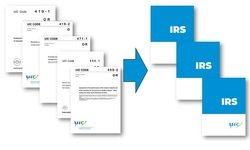
New working groups launched to continue the IRS migration process

7 September 2026
Translating ideas into impact: How the UIC Academic Board for Innovation is driving global rail collaboration

7 September 2026
UIC launches a new cycle of the UIC Global Mentoring Programme for Railway Talent

27 July 2026
Rolling stock training programme successfully completed in Ankara

27 July 2026
Register now for the UIC webinar on railway fuel filtration for internal combustion engines
24 July 2026
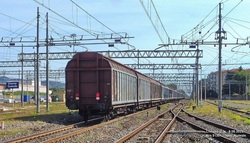
Latest UIC publications on rolling stock
23 July 2026
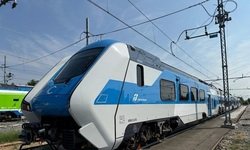
UIC visits the Hitachi Rail plant in Pistoia, Italy
 now: 1790121600 date: 1790121600
The UIC Sustainability Impact Awards 2026
2026-09-23 18:00:00
 now: 1790121600 date: 1790121600
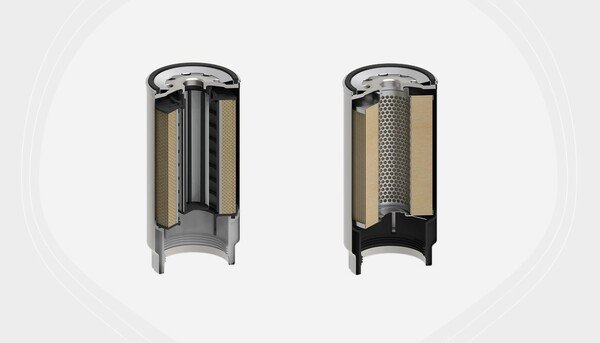
Railway Fuel Filtration for Internal Combustion Engines
2026-09-23 00:13:33
 now: 1790121600 date: 1790121600
UIMC Congress 2026
2026-09-23 00:13:33
 now: 1790121600 date: 1790121600
UIC Standardisation Day
2026-09-23 00:13:33
 now: 1790121600 date: 1790121600
Excellence in Railway Publications Award 2026
2026-09-23 00:13:33
 now: 1790121600 date: 1790121600
56th Watford Conference
2026-09-23 00:13:33
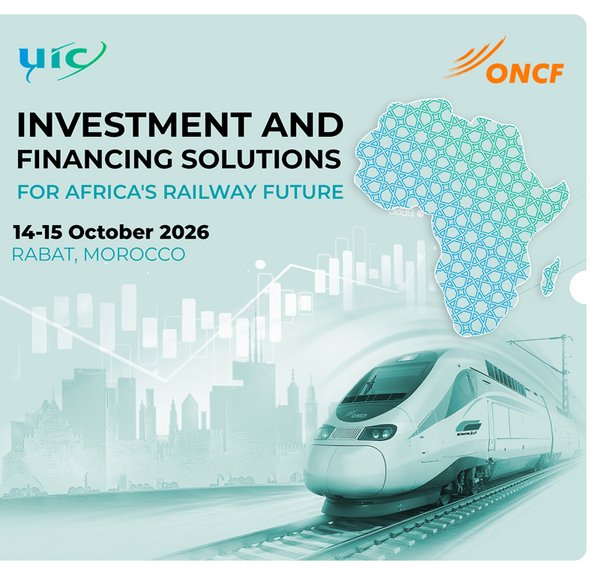 now: 1790121600 date: 1790121600
Investment and Financing Solutions for Africa’s Railway Future
2026-09-23 00:13:33
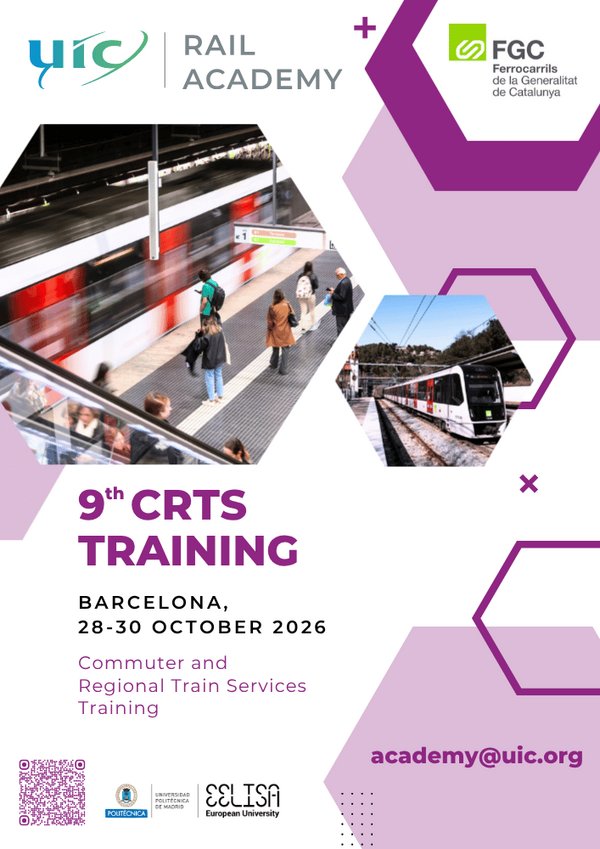 now: 1790121600 date: 1790121600
9th Training on Commuter and Regional Train Services
2026-09-23 00:13:33
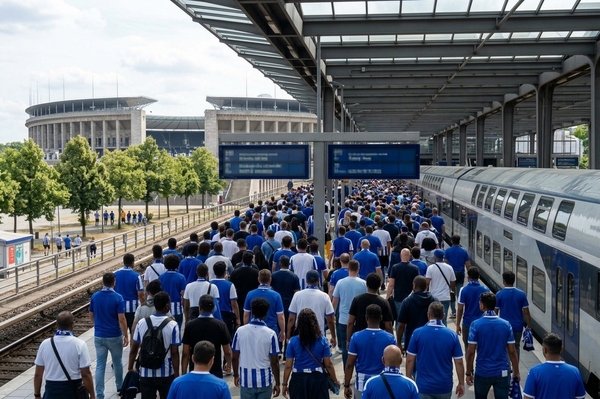 now: 1790121600 date: 1790121600
Africa Region Training session: Security of major events
2026-09-23 00:13:33
 now: 1790121600 date: 1790121600
5th Global FRMCS Conference
2026-09-23 00:13:33